 Sir Thomas Johnstone (!850-1931) Lipton was a British merchant who started as a small tea seller, and led the great Lipton Tea to a worldwide advancement and enjoyment. Thomas spent some years in the United States and returned to his hometown Glasgow and owned his own small grocery store. He was so dedicated even in his small business that he became a millionaire at the age of thirty. Thomas began thinking about how the public can easily enjoy all the foods in his store, but the tea's were very expensive and not everyone could afford them. His concern led him to make a very tasty tea called Lipton Tea which became popular throughout and is still complimented by people today.
Friday, December 4, 2009
Sir Thomas Johnstone Lipton (Lipton Tea)
Sir Thomas Johnstone (!850-1931) Lipton was a British merchant who started as a small tea seller, and led the great Lipton Tea to a worldwide advancement and enjoyment. Thomas spent some years in the United States and returned to his hometown Glasgow and owned his own small grocery store. He was so dedicated even in his small business that he became a millionaire at the age of thirty. Thomas began thinking about how the public can easily enjoy all the foods in his store, but the tea's were very expensive and not everyone could afford them. His concern led him to make a very tasty tea called Lipton Tea which became popular throughout and is still complimented by people today.

Wednesday, December 2, 2009
Treaty of Nanjing (Opium War)

The treaty of Nanjing was signed on August 29, 1842. It marked the end of the opium war between the Qing Empire and the British Empire. The treaty heavily favored the British because of the fact that the British had won the won by the end. The British would obtain 21 million dollars when the treaty was signed and would gain another 15 million in the next three years. They would also gain control of numerous ports and cities in China including Hong Kong. The Chinese gained almost nothing from this treaty but it was the only way they could obtain peace. This picture shows the signing of the treaty.
Picture from
http://en.wikipedia.org/wiki/File:Nanjingtreaty.jpg
Info from
http://galenet.galegroup.com/servlet/History/hits?docNum=BT3403700875&tab=4&locID=menlo_schlib&nav=1&origSearch=false&hdb=ALL&t=RK&s=1&r=d&items=0&secondary=false&o=&sortOrder=RE&n=10&l=dE&sgPhrase=false&c=1&tabMap=5&bucket=psm&SU=Treaty+of+Nanjing
Primary Source in 1851

As I was looking through the New York Times, I spotted an article from way back in October of 1851. I clicked onto the link and I found an article talking about who and what inventions had been brought to the Great Exhibition of 1851. I obviously knew a couple of them brought since we learned about so many in the Industrial Revolution unit. Some inventions that were at the fair that I knew was the Cotton Gin. We all know who and what the Cotton Gin was and so I found it very interesting that it was being showed off at the Crystal Palace. Another one we all know is the Reaping Machine. I remember reading about the reaper and how it saved men from working all day in the fields. Also, inside this primary source were a list of awards that these inventors got for their amazing invention. Some catagories of awards were, Council Medals, Prize Medals, Honorable Mention, and the Money Award. Each award was given to numerous amounts of people, since everybody was split into their own "Class." Each class was filled with the almost the same invention. For example, "Class II" was all food related items that were being showed off. There was maple sugar, soft wheat, flour, etc. Some "Classes" had only one item included in it because that meant that invention was unique and there was nothing else that closely resembled to it. An example of that would be the Mechanical Reclining Chair. It was a very interesting and unexpected find from W. Ragan. This primary source really made me think about how little our world was before the Industrial Revolution. I cant even think about being alive, without a place to stay, having my parents be gone all day and then once they come home all they want to do is sleep, or have none or little food set at my table. I am grateful for the fact that I do have those things, and if it wasn't for all these intelligent thinkers, the world would not be like it is today. Furthermore, primary sources are a good source of data because they teach you a lot about what was happening exactly in the time you are talking/researching about. I find it hard to read a secondary or even third source about the Industrial Revolution because you really don't know what it was all about unless you were actually there.
Attached is just a small snipit of what the article looks like, since the full article is too big to be posted.
Crystal Palace

The Great Exhibition of 1851 took place in the beautiful Crystal Palace, which located at the time, was in the heart of London. People from all over the world came to either show off their invention or come to look at all the prized possessions. The Crystal Palace held more than 12,800 square feet for all of the famous inventors to show off their masterpiece. In addition, the Crystal Palace was later used for numerous more events than just the first world fair ever to be done.
Citation of picture- http://www.ursusbooks.com/thumbnail.php?img=./itemimages/123543a.jpg&maxwidth=700
Isabella Bird
The book that Isabella Bird wrote Six Months in the Sandwich Islands, this book gave readers vivid pictures of the geology and also it introduced them to a new culture. This book talked about Isabella's journey in Hawaii, she climbed to the tops of volcanoes and visited the rain forests. The book gave a deeper understanding to the cultural which is essential. I mentioned in my last blog that the idea of Europeans being superior than other races was an idea that was held very highly in the Western. However Isabella was able to go against this idea because she had the experiance. She traveled to these places like Hawaii and learned about the people and their culture. There was more to them than Europeans saw and she was able to see it. Isabella didn't start the idea of all humans from different races are equal but she was one of many who set this idea in motion. Along with this her books uncovered places and "worlds" that they didn't know of. In Africa the Westerners colonized them but here she saw them in their natural life styles, she allowed the people to be themselves which uncovered these "barbarians" for what they really were.
Levin, Ruth. "Splendid Possibilities: Isabella Bird Visits Hawai'i in 1874." OAH Magazine of History. JSTOR. < search="yes&term=" term="Isabella&list=" searchuri="%2Faction%2FdoAdvancedSearch%3Fq0%3DIsabella%2BBird%26f0%3Dall%26c0%3DAND%26q1%3D%26f1%3Dall%26c1%3DAND%26q2%3D%26f2%3Dall%26c2%3DAND%26q3%3D%26f3%3Dall%26wc%3Don%26Search%3DSearch%26ar%3Don%26sd%3D%26ed%3D%26la%3D%26jo%3D%26dc.History%3DHistory&item=" ttl="264&returnArticleService="> (Dec 2, 2009).
Levin, Ruth. "Splendid Possibilities: Isabella Bird Visits Hawai'i in 1874." OAH Magazine of History. JSTOR. < search="yes&term=" term="Isabella&list=" searchuri="%2Faction%2FdoAdvancedSearch%3Fq0%3DIsabella%2BBird%26f0%3Dall%26c0%3DAND%26q1%3D%26f1%3Dall%26c1%3DAND%26q2%3D%26f2%3Dall%26c2%3DAND%26q3%3D%26f3%3Dall%26wc%3Don%26Search%3DSearch%26ar%3Don%26sd%3D%26ed%3D%26la%3D%26jo%3D%26dc.History%3DHistory&item=" ttl="264&returnArticleService="> (Dec 2, 2009).
Isabella Bird

This image shows Isabella Bird, she was a traveler, explorer, and writer. Isabella was ill as a young women, and her doctor recommended her that she traveled henceforth she took her bags and set off to see the world. The places she visited were Colorado, Hawaii, Japan, Tibet, and more. Her health got better with the traveling. Also the books that she wrote on journeys, that are still read today, gave insight on eastern cultures which were challenged by Western stereotype. Which as we all know, was very big deal because the Europeans considered themselves superior to others. Isabella saw what these people could do instead of seeing what they looked like. Also she presented new knowledge of places not well known to the rest of the world. She was an explorer in a sense because she visited lands that were not well known to the world and she wrote down what she saw and her journeys in some books. Once Isabella's traveling began it did not end you can say she had a passion for traveling and with it she was able bring new ideas that could of lead to larger ones. Personally, I think that Isabella could of also help establish the idea of an independant women because she traveled mostly alone with the ocasional companion that she met along the way. However a women alone and looking after herself, was frowned upon by the Western society.
Image and info:
"Isabella Bird." <> (Dec 2, 2009)
Primary Source: Statue of Liberty
The New Colossus, by Emma Lazarus
Not like the brazen giant of Greek fame,
With conquering limbs astride from land to land;
Here at our sea-washed, sunset gates shall stand
A mighty woman with a torch, whose flame
Is the imprisoned lightning, and her name
Mother of Exiles. From her beacon-hand
Glows world-wide welcome; her mild eyes command
The air-bridged harbor that twin cities frame.
"Keep, ancient lands, your storied pomp!" cries she
With silent lips. "Give me your tired, your poor,
Your huddled masses yearning to breathe free,
The wretched refuse of your teeming shore.
Send these, the homeless, tempest-tost to me,
I lift my lamp beside the golden door!"
My Analysis:
Above is a poem I found that describes the Statue of Liberty. The statue itself sends a message to people and nations. A message that states her "commanding" presence, her "mighty" stature, and her "welcoming" nature. All of these are meant to describe the U.S. as a country. The golden door is America. The Statue of Liberty represents the U.S. for the rest of the world.
http://galenet.galegroup.com/servlet/History/hits?docNum=CD2154000050&tab=4&locID=menlo_schlib&nav=1&origSearch=false&hdb=ALL&t=RK&s=1&r=d&items=0&secondary=false&o=&sortOrder=RE&n=10&l=dE&sgPhrase=true&c=1&tabMap=119&bucket=psm&SU=%22statue+of+liberty%22
Not like the brazen giant of Greek fame,
With conquering limbs astride from land to land;
Here at our sea-washed, sunset gates shall stand
A mighty woman with a torch, whose flame
Is the imprisoned lightning, and her name
Mother of Exiles. From her beacon-hand
Glows world-wide welcome; her mild eyes command
The air-bridged harbor that twin cities frame.
"Keep, ancient lands, your storied pomp!" cries she
With silent lips. "Give me your tired, your poor,
Your huddled masses yearning to breathe free,
The wretched refuse of your teeming shore.
Send these, the homeless, tempest-tost to me,
I lift my lamp beside the golden door!"
My Analysis:
Above is a poem I found that describes the Statue of Liberty. The statue itself sends a message to people and nations. A message that states her "commanding" presence, her "mighty" stature, and her "welcoming" nature. All of these are meant to describe the U.S. as a country. The golden door is America. The Statue of Liberty represents the U.S. for the rest of the world.
http://galenet.galegroup.com/servlet/History/hits?docNum=CD2154000050&tab=4&locID=menlo_schlib&nav=1&origSearch=false&hdb=ALL&t=RK&s=1&r=d&items=0&secondary=false&o=&sortOrder=RE&n=10&l=dE&sgPhrase=true&c=1&tabMap=119&bucket=psm&SU=%22statue+of+liberty%22
Periodic Table #2
Began by organizing the elements by atomic weight and realized that they would go from a halogen to an alkali metal to an alkaline earth metal
From 1869-1871 he revised and added the elements to fit into the table he had created
He altered the accepted atomic weights to make them fit because there were the transition metals and the rare earth metals that didn’t fit the pattern that he discovered before
Many people were questioning his decision to change the elements masses but they thought that they organization was good and so it might work out. He was also considered one of the greatest chemists at the time.
Sacks, Oliver. “Best Invention Everything in Its Place.” New York Times Magazine. April 18, 1999. Newsbank. http://infoweb.newsbank.com/iw-search/we/InfoWeb?p_product=AWNB&p_theme=aggregated5&p_action=doc&p_docid=11421F7941D12DC6&p_docnum=4&p_queryname=2
Mendeleev’s Table. History Resource Center: World. http://galenet.galegroup.com/servlet/History/hits?docNum=CD2210013968&tab=16&locID=menlo_schlib&origSearch=false&hdb=MW&t=RK&s=1&r=d&
items=0&secondary=true&o=&sortOrder=RE&n=10&l=dI&sgPhrase=true&c=1&tabMap=114&bucket=
img&SU=periodic+table
From 1869-1871 he revised and added the elements to fit into the table he had created
He altered the accepted atomic weights to make them fit because there were the transition metals and the rare earth metals that didn’t fit the pattern that he discovered before
Many people were questioning his decision to change the elements masses but they thought that they organization was good and so it might work out. He was also considered one of the greatest chemists at the time.
Sacks, Oliver. “Best Invention Everything in Its Place.” New York Times Magazine. April 18, 1999. Newsbank. http://infoweb.newsbank.com/iw-search/we/InfoWeb?p_product=AWNB&p_theme=aggregated5&p_action=doc&p_docid=11421F7941D12DC6&p_docnum=4&p_queryname=2
Mendeleev’s Table. History Resource Center: World. http://galenet.galegroup.com/servlet/History/hits?docNum=CD2210013968&tab=16&locID=menlo_schlib&origSearch=false&hdb=MW&t=RK&s=1&r=d&
items=0&secondary=true&o=&sortOrder=RE&n=10&l=dI&sgPhrase=true&c=1&tabMap=114&bucket=
img&SU=periodic+table
Pages 604-605
In Africa, during precolonial times, women were always active farmers. They worked with their husbands to farm the land, planting crops and harvesting them. Along with that the women were expected to care for children, and food preparation. Women were expected to feed their families.
But during colonial times as economic demands grew, women’s work load grew much more. Cash crop farming became very popular. Men withdrew from subsistence farming and began to become involved with all money aspects of cash crops. This left the women with a doubled workload. They had to feed their family and husbands, and they had to work hard to produce the cash crops that their husbands were selling. Their work hours went from 40 a week to 70 a week from precolonial times to 1924. Also, men moved to cities seeking employment, leaving the women alone on the farms. The women had to complete all domestic work, and they had to provide food for their husbands because the wages in the cities were very low. Women headed 60% of households, because 60% of men migrated to urban areas.
Women began to face economic opportunities. They would sell cloth, various foods, and inexpensive imported goods, while their husbands dealt with the more profitable goods. Women began to be viewed as independent head of households, and tried to escape patriarchal values.
Shackleton and Discovery

This is a picture of Ernest Shackleton's ship crashing in Antarctica. Shackleton was an explorer of the late 1800s and early 1900s. His goal was to become the first explorer, along with his crew, to cross Antarctica through it's central pole. During the expedition, their ship got stuck in the Antarctic ice. Two rescue ships were sent, but neither could get close enough to Discovery (the original ship) to free it from the ice. However, in february of 1904, some of the Antarctic ice began to break around Discovery, and Shackleton's ship was freed.
World's First Ferris Wheel- picture and source
 The world's first ferris wheel, named after George Washington Gale Ferris, Jr. was invented in 1893 with the sole purpose of being displayed at the World's Columbian Exposition in Chicago, Illinois. It became one of the world's largest attractions, and I look forward to learning more about this topic.
Economies of cash-crop agriculture and wage labor- connections between then and now
Along with the many changes that the early European culture experienced, some migration also took place. As stated on page 602 in Ways of the World,“Driven by the need for money, by the loss of land adequate to support their families, or sometimes by the orders of colonial authorities, millions of colonial subjects across Asia and Africa sought employment in European-owned plantations, mines, construction projects, and homes.” Large European-financed plantations began growing sugarcane, rubber, tea, tibacco, and sisal, along with multiple other items that lured thousands, including those from India, China, and Java. What came with this however were poor working conditions, disease, gender discrimination, and poor pay. The migration to European farms or plantations was more common in Africa than in Asia, due to the fact that the lose of jobs was on the increase in Africa. With the help of colonial governments, the “settler colonies” of Africa (Algeria, Kenya, Southern Rhodesia, South Africa) were able to have large land masses in their possession which has once been the home of multiple African societies. More of the land was granted to whites, who were by this point making up about 20% of the population. Mining became a primary source of wage labor for a growing amount of people, however the working conditions were despicable. Whites and blacks were beginning to experience discrimination now more than ever before. Well-educated whites were able to find business opportunities as doctors, teachers, professional specialists, and jobs of that nature. Those of the opposite skin color, however, were unable to find work so easily. Racial segregation was introduced.
To be honest, in order for me to make connections between the lifestyles of both Africans and Asians both past and present, I would need to be more educated on the topic. I feel as though my knowledge on the matter is based off of mere stereotypes, or whatever the latest I am hearing on the news regarding one of the two locations. Now that we will be learning and discussing the history of both Africa and Asia, I feel as though I should learn more about the present day aspects of both areas. The connections I can make, however, is that Asia was and is still a huge exporter of goods for around the world, and that Africa continues to experience racial segregation.
Darwin

Darwin was the scientist who started the theory of evolution. He not only believed this, but he made it public. As he published books, more and more people started believing in this theory, and soon much of the population believed in evolution. This picture shows that some of Darwins beliefs were that man evolved from apes. Darwin had many other interesting beliefs on how everything worked, and that is why I want to learn more about him.
Ota Benga

This picture is of Ota Benga, the African Pygmy who was brought from the Congo to live in the Bronx Zoo in New York. This action shows the start of classifying races in American and European society in the late 1800s early 1900s. Instead of seeing this as something cruel, this was regarded as scientific, and the exhibit was something that was "intriguing" for everyone to see. Ota Benga was placed in the same habitat that the monkeys were in, which showed how the European mind classified races at the time. The zoo director William Hornaday apparently saw no difference between an orengutan and a "little black boy".
I got my picture here.
I got some information here.
Tuesday, December 1, 2009
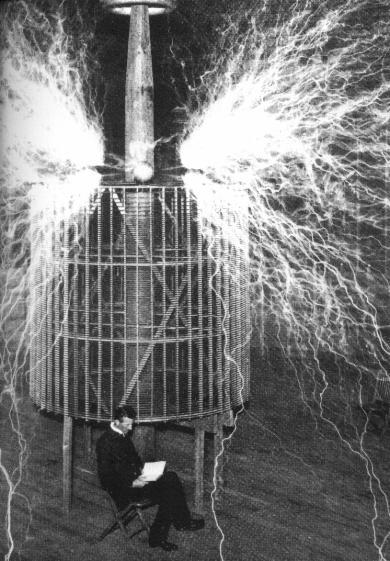
Nikola Tesla

Nikola Tesla was the mad scientist of the 1800's, he created many contraptions relating to electricity and showed them off to masses. As you can see above, Nikola Tesla is sitting inside a cage as jolts of electricity travel around him, without actually touching him. The cage protects him as a tesla coil sends an immense amount of energy outward all around him. The reason we call him mad, is because he's sitting inside reading a book as if he hasn't even been phased by this experience. Tesla went on to try other experiments with electricity and always put himself in the spotlight when he performed his scientific wonders. I got my picture here.
Richard Owen
Sir Richard Owen was the person who came up with the term "dinosauria." Dinosauria came from the Greek words "deinos" (fearfully great) and "sauros" (lizard). He recognize these beings as very large, but extinct reptiles.
From a group of fossils of a few different dinosaurs, he found a couple big differences between the bones structures of living reptiles and these fossils. One big difference was that the fossilized reptiles all had column like legs (legs that were directly underneath the body like a lion's or a dog's) instead or legs that sprawled out to the side like the common lizard's. Another thing he found was that the fossils contained five vertebrae that were fused together and attached to the pelvic bone.
Owen first published his findings in 1842 in the Proceedings of the British Association for the Advancement of Science. He mentioned the new distinct class of creatures and how they were enormous in comparison to the reptiles living at the time. He also went over his reasoning behind the name "dinosauria" and some basic characteristics of what he thought dinosaurs were probably like. In total, Owen named and described around 20 different dinosaurs and was the first person to ever do such work.
Enchanted Learning. Sir Richard Owen. 1998. <> December 1st, 2009.
Opium Wars

The opium wars took place during the 19th century and had lasting implications on both China and the surrounding nations. The wars were based off of disputes between the China when they were under the Qing Empire and the British Empire. I am going to go into more research about the Opium Wars and their lasting affects on the world. This picture is one of the most famous pictures because it represents the burning of a British trade ship while it was coming into a Chinese port. I am not sure why the text is underlined.
Lipton Tea
 Sir Thomas Johnson Lipton is the original owner of Lipton Tea. This newly created tea was first started in Glasgow, Scotland. Sir Thomas's initial goal was to go out and search for the best tea with high quality but also a reasonable price for others enjoyment. He first came to this idea because before Lipton tea, other tea's were very expensive. Sir Thomas's accomplished goal stood right when he established his first tea packing company in Hoboken, New Jersey. Sir Thomas led the U.S to further success because Lipton controlled 50 percent of the tea making in America around the 1990's.
Antarctica
 John Davis (pictured above) was the first person to step foot on Antarctica on Febuary 7, 1821.
The Periodic Table


Citations:
Vucinich, Alexander. Mendeleyev, Dmitry Ivanovich. http://galenet.galegroup.com/servlet/History/hits?docNum=K3404100815&tab=32&locID=menlo_schlib&origSearch=false&hdb=MW&t=RK&s=1&r=d&items
=0&secondary=true&o=&sortOrder=RE&n=10&l=dB&sgPhrase=true&c=1&tabMap=114&bucket=bio&SU= periodic+table (accessed December 01, 2009)
Pictures from:
http://galenet.galegroup.com/servlet/History/hits?docNum=CD2210013968&tab=16&locID=menlo_schlib&origSearch=false&hdb=MW&t=RK&s=1&r=d&
items=0&secondary=true&o=&sortOrder=RE&n=10&l=dI&sgPhrase=true&c=1&tabMap=114&bucket=
img&SU=periodic+table
http://www.bpc.edu/mathscience/chemistry/images/periodic_table_of_elements.jpg
Subscribe to:
Posts (Atom)