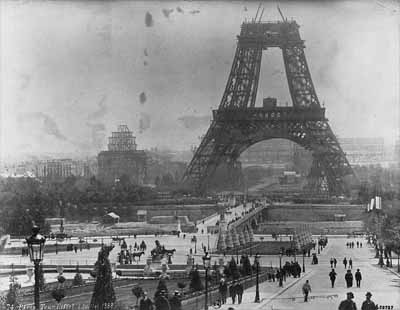
 This is a picture of the Eiffel Tower being built in Paris in 1887. As you see in this picture this is just as the tower was going up. It took two years until completed and it was built by Gustave Eiffel. This was just part of the world fairs and was not intended to stay up forever. As you can see in this picture Paris was not as hopping as it is today and the Eiffel tower has something to do with the tourist in PAris.
Monday, November 30, 2009
Eiffel Tower
This is a picture of the Eiffel Tower being built in Paris in 1887. As you see in this picture this is just as the tower was going up. It took two years until completed and it was built by Gustave Eiffel. This was just part of the world fairs and was not intended to stay up forever. As you can see in this picture Paris was not as hopping as it is today and the Eiffel tower has something to do with the tourist in PAris.

Statue of Liberty

The Statue of Liberty was shown on October 28th, 1886. The tower was a gift from France, originally named: "Liberty Enlightening the World". The statue stands at Liberty Island in New York. At the time, President Grover accepted this gift as a monument to celebrate 100 years of American Independence.
http://galenet.galegroup.com/servlet/History/hits?docNum=BT3401804032&tab=1&locID=menlo_schlib&origSearch=true&hdb=ALL&t=RK&s=1&r=d&items=0&secondary=true&o=&sortOrder=&n=10&l=dR&sgPhrase=true&c=1&tabMap=119&bucket=gal&SU=%22statue+of+Liberty%22
http://www.kakambourasfamily.org/wp-content/uploads/2009/10/StatueofLiberty1939WF2.jpg
Sunday, November 29, 2009
Tokugawa and Meiji Restoration- Digging Deeper
Read 1 and blog about how a specific area interacted with European forces. What were colonizing motives? How did the people being colonized respond?
Prior to U.S. Commodore Matthew Perry's arrival, Japan was governed by a shogun, or military ruler, who was a descendant from the Tokugawa family. They were a a largely influential family in Japan's history due to the fact that they acted "in the name of a revered but powerless emperor." (page 578, Ways of the World) The expectation of this shogunate was to at all costs protect Japan from the return of civil war with 260 daimyos, or rival feudal lords.
The shoguns were able to provide Japan over two centuries of peace, thanks to their own military power and political skills. In order to stay colonized and control the daimyo, they placed strict regulations on internal travel and communication and "required the daimyo to spend alternate years in the capital of Edo, leaving their families behind as hostages during their absence." (page 578, Ways of the World) However, due to the fact that by default the daimyo were the more powerful ones, they began acting as if they were independent states. They built separate military forces, law codes, tax systems, and currencies. Tokugawa Japan had no national army, however, along with no uniform currency and hardly any central authority at the local level, meaning they were "pacified...but not really unified." (page 578, Ways of the World) In order to further colonize the country, the Tokugawa placed strict and detailed guidelines for governing the occupation, residence, dress, hairstyles, and behavior of the four status groups, ranked hierarchically. The Japanese social structure was divided into four groups:
1) samurai
2) peasants
3) artisans
4) merchants
As time went on, Japan needed to make sure that it could stay united and colonize its people. As the substantial burst of economic growth, commercialization, and urban development came to be, peace is what came along with it. Japan was becoming on of the world's most urbanized countries. Education was becoming of prime importance as well, with 40% of men and 5% of woman able to read and write, which was a huge improvement. The growth of importance of education was subconsciously building Japan a remarkable industrial foundation and in turn colonized the people and the future of Japan.
The samurai, who once lived only by the sword, were broadening their horizons as well. They discovered the importance of business and commerce and drifted from the long held tradition of honoring the warrior code. They still ranked highest on the social pyramid, however were not as educated in the business aspect of society. This led to some anarchy, for now the social status were experiencing some disorder. Peasants began moving to cities and taking the jobs of artisans or merchants. According to a decree of 1788, the peasants "have become accustomed to luxury and forgetful of their rain..." (page 579, Ways of the World) This led to the shogun declaring that all luxury items must be avoided by the peasants, which was, like many others decrees, ignored.
The attempt at colonizing Japan, some successful and others not, led to widespread corruption. Unfortunately, the shogunate were losing control.
However, this the shogun's downfall led to the Meiji restoration. At this time, "the country's new rulers claimed that they were restoring to power the young emperor, then a fifteen-year-old boy whose throne name was Meiji, or Enlightened Rule." (page 580, Ways of the World) Now that the shogunate were eliminated, the new patriotic leaders of the country made clear their goals-- "to save Japan from foreign domination, not by futile resistance, but by a thorough transformation of Japanese society, drawing upon all that the modern West had to offer." (page 580, Ways of the World) Knowledge became a greatly influential aspect to the countries transforming society, and was greatly motivated "so as to strengthen the foundations of imperial rule." (page 580, Ways of the World)
All in all, Japan underwent multiple changes throughout the late sixteenth and early seventeenth centuries. The shoguns held power for an extended amount of time, and were able to colonize the country for as long as they could. The social pyramid experienced a bit of a shaking up, if you may, and the samurai's lifestyle underwent a modernized makeover. Corruption was slowly taking over the Tokugawa regime, and Japan experienced a bit of a rough patch regarding a visit from Commodore Perry in hopes of opening more ports for trade. The Meiji restoration was soon after underway, slowly but steadily attempting to repair the areas needing mending in Japan. As a whole, Japan did a sufficient job in keeping itself colonized and the changes that took place did have both a positive and negative effect on society, however never posing a drastic transformation.
Tells of Atrocity in Belgian Congo
In the reading (599-600) it talks about the outrages being widely publicized in Europe. So I thought I would look for one of those articles, and I found one. It is from the New York Times in 1909. It talks about a little 2 year old boy from Congo, and how important he was and how everyone on the ship wanted to shake his hand. It also sort of shows how long it took people to hear about what was happening around the world because we now know that by 1908 Leopold's reign of terror was already over.
Here is the Link.
Opium War/Anglo-Chinese War
In the 1830's the British had a huge drug cartel, one bigger than any drug cartels today. They were growing Opium/Poppies in India and having it shipped out to them by the East India Trade Company. The company shipped lots of opium which were then traded for Chinese goods and other things like that. This massive amount of opium being distributed created a country filled of drug addicts. In 1836 trafficking became illegal but the British would just bride the officials. The amount of opium in China was getting smaller and smaller. The addicts were getting sadder and sadder. This period of time was called the Great Tragedy and to help ease the pain of not having the drugs, the emperor made opium illegal. The English were still sending ships trying to get the drugs into the country. China decided that they would just go out and force the ships to turn around and not bring the drugs into their country. Well, this idea worked but gave the English another idea, they could just bring warships with them on their trafficking trips. Now the Chinese warships were nothing compared to the English, with their gunships. The British would go back and forth on the coast firing at forts and fighting on land. Finally the Chinese were forced to agree to the Treaty of Nanking, which made it so that all British people on Chinese soil committing a crime would be subjected to British law. No restrictions were placed on the British trade into China, so the drug trafficking doubled, and the opium levels grew once again.
I learned everything off of this site. Here!
Saturday, November 28, 2009
Economies of Coercion
During the colonial era, there was much more demand for labor for local projects and building infrastructure. Also, labor was needed to harvest natural products. Of course this labor had to be unpaid. In Africa, specifically the Congo, many natives were forced to collect rubber for Belgium (Leopold II). This was required by law, that you were required to work 10-12 days a year without pay. Although it doesn't seem that bad, they were treated poorly. It escalated to the point where if they could no longer retrieve rubber, Leopold and his men would go to the villages and kill innocent people. Eventually, many people got word of this, causing Belgium to take control over the Congo. This in turn ended Leopold's "reign of terror."
In the Netherlands, a similar system was put into place. Peasants were required to cultivate 20% or more of their land in cash crops to pay for taxes. These crops were sold to the government at low rates and then sold off to the rest of the world making a lot of profit. Once again, if people could not cultivate their land, they would be lashed and often starved.
I had always thought that Africans were only taken out of Africa and then forced into labor. I did not know that there were enough valuable natural resources within Africa for Europeans to force labor there as well. In the end, throughout history nations have taken advantage of African people in order for cheap labor. Unfortunately this led to massacres of thousands of people.
Strayer 566-569
After reading about China and Europe's conflicts over Opium and the beginning of the first Opium War, I felt as though the entire situation could have been avoided.
Based on what I read, it was obvious that Britain took complete advantage of China after the Opium war. Britain, with its high ego because of their new military, decided to wage war against China. Soon after, China signed Britain's treaty which was completely in favor of Britain and allowed them to open numerous ports in China and impose tariffs on goods. The same thing happened after Britain won the second Opium War. It is clear that China let Europe push them around, taking control of the ports and allowing Europeans and other foreigners to live in China under their own laws. China, previously a very powerful nation, has fallen at the hands of Europe and their weakened government was the result of Imperialism. Why was China so feeble? Why did they let Europe and other nations such as France and Japan take advantage of them and control of areas of their country? Most likely, China underestimated Europe's newfound power, especially after the effects of the Industrial Revolution.
Friday, November 27, 2009
Edward Blyden
Edward Blyden was the most influential proponent of identifying the differences between Africana and European cultures. Some of his views consist of race and culture. He stated that each race is different, but that it had its own distinctive benefaction that it gave to the world and its population. For example, Africans had taken on a different approach of life compared to the Europeans. As the Europeans were so eager to get ahead in life by their materialistic and individualistic ideas, the Africans were happier being more spiritual and cooperative. Both of their missions were contrasted sharply because they were focused on two completely different things. Blyden figured this out and annonced his views to the world and people realized they could do the same things that the Europeans could just in a different manner. As a result, hundreds of thousands Africans contributed to World War I, where they were faced to coexist with the Europeans. People thanked Blyden for his intelligence and later on people began to called the Africans a "tribe" instead of a race because they felt it was a better word to describe them as.
The Wage Labor
Working for Europeans was always the way to obtain money in these economies. In order to get money, they had to do some manual labor at a very small price. This labor is called the wage labor. Money earned from a man doing the job himself. Some of this wage labor was brought to many different parts of Africa and Asia. It was populated the most in the continents because African and Asian people were known to look up to the "whites", also known as Europeans, and do whatever they were told. Some types of wage labor included plantations, mines, construction sites, and building homes. These labor sites were located in many countries in Africa. For example, Trinidad, Fiji, Malaysia, Ceylon, and South Africa had very many plantations where the Africans could work at. Some ideas of labor were moving extremely heavy sacks of tea into a drying house so they could be exported to different parts of the world. Mines were probably the largest area of wage labor because over the 19th century, they found 55% of the world's tin. As a result, the Africans and Asians got a lot better at what they did and finally began to get higher paying jobs and less hours on the job. However, they would never fully be as rich as the Europeans.
Citation: The Ways of the World by Robert W. Strayer
Citation: The Ways of the World by Robert W. Strayer
Colonializing in the 1800s
European Colonial Empires were very different than many of the other colonial empires in the nineteenth century. One of the very strongest differences was the race factor. There was something called "scientific racism" where they based racism off the studies of all different types of races. As a result, whites were the most dominant race and were seen as a higher being to the other races. The Africans called the white people "bwana" which means master in swahili, and the Europeans or "white" people called the africans "boy." Another difference was the seperation of the Africans from the Europeans. Most colonial empires didn't supply seperate homelands for the black and white people, so it brought them closer together as a whole. These new European colonial empires demanded to have separate homelands, educational systems, and even public facilities. Furthermore, European Colonial Empires were liked more than the original colonial empires and therefore, people adapted to their empires and that is how scientic racism began. It lasted until the end of the 19th century and was a horrible era for everyone.
Citation: The Ways of the World by Robert W. Strayer
Citation: The Ways of the World by Robert W. Strayer
Thursday, November 26, 2009
Strayer 528-529
These next few blogs are a bit late but I'd still really appreciate your comments, thanks.
After reading this section (and after completing the unit :O), it's pretty accurate to say that the most important things that came from the industrial revolution are the technologies created such as the spinning jenny, power loom, steam engine and cotton gin as well as factory systems that were brought into play. Unfortunately, these machines only benefitted factory owners, allowing them to produce more and make more profit. However, the actual laborers were had a much harder lifestyle and made very little money in comparison to factory owners. This is why many families had to send their children off to work in order to make as much money to support them as possible.
Present industrial feats occur all the time with the advancement in technology. However, it is never and probably will never be on the same scale as the Industrial Revolution was in Britain. This is because at that point in time, one invention after another surfaced, modernizing the country and world. Unfortunately, another industrial revolution will most likely not occur unless some sort of futuristic/alien (foreign) technology is created or discovered.
Tuesday, November 24, 2009
African Women pg (204-205)
In the Strayer reading about Women in Africa it said that the women did a lot of the active work. Active work includes, farming, weeding, planting, harvesting, and taking care of the children of course. All women seem to have taken care of the children and still to this day, women are known for caring for children more then the men are. Men did more of the labor like building houses and clearing the land, but we are not going to discuss them in this blog.
Once the economy grew and the necessary of money was higher, the women's jobs different more then the men and became more separate. The women initially started the cotton crops so that they could have clothes for their families, but as the cotton need grew and the money started going for cotton the men took the crops from the women and were in control. In pre-colonial time the women worked a lot less then during the colonial time, because more work meant more money, and more money meant a better life. And all women were in it for better life, not just for them, for their family as well. Families were extremely important to African women because they really did not have that good of jobs and usually their jobs were dealt with around the house, or where the family was.
The Ethnic Identity of Africa
With the Europeans conquering Africa, the natives of Africa began to see that they had one common "enemy" in the white people. By establishing this enemy, there was development of unification all across Africa with the people now considering themselves a race. Even though there still were enemies within the tribes of Africa, the natives began to think of themselves as a seperate race from the White people. This was vital for the Africans to develop this sense of community and race, because through this connection, they had become united as a continent. This ethnic identity helped the Africans understand themselves and it was vital for the nations of Africa. By having this ethnic identity, the Africans began to start these "mini-revolutions" that would eventually expel the White people from Africa and would let the Africans live and thrive for themselves. The philosophers that started thes beliefs started what would become the common beliefs for the natives for many years to come.
Ways of the World Strayer
Education in the Colonial Era
In the Colonial Era, education was vital for awareness of the world and its surroundings. Education was not only to learn about the world around them, but also an escape from manual labor. It also gave the opportunity to be placed in better paying jobs. There were also cases where education was used for power control. As the Europeans went through Africa, they installed beliefs and ideas that helped them maintain power through education. Others were embracing European culture as well. Some would speak the language of France and also dress like them, and have weddings like them. This helped the development of Africa because of the fact that they ca “blend” in with the white people. By blending in, it would open up doors for the Africans, which would allow them to access European technology and philosophies.
Race and Tribe
Towards the end of the 1800s, many African thinkers began defining "African identity." Before this mini-revolution, there were virtually no people on the continent who regarded themselves as Africans. People were often defined by their language, kinship, and their land of origin. One other way to define Africans was to contrast them with European cultures. The word "tribe" started appearing more and more.
As Europeans continued to overtake Africa, the Africans did the best they could to continue there traditions and keep their spirits alive. The British found that the Africans were easier to control if they separated them into different clans. This wasn't easy, though because the Africans usually just wanted to be able to live how they wanted, and not be split into certain sections of society. They would rather be one big community than a divided nation. However, they did not have much of a choice when the colonial government required people to identify what tribe they were a part of on things like applications for jobs and ID cards. Although they initially did not seem in favor of the whole idea of tribes, the Africans began to take a liking to the new system and found the labels useful, especially in areas were urbanization was happening very rapidly.
It was much easier to organize people when they were part of a tribe. In colonial colonies, people that were new to the city found themselves new "tribes" of people who spoke the same language, came from the same place, or worked in the same field. Another step in society came when people started to include themselves in more than one tribe. A man could be in a clan of factory workers at the same time he was in a group of people who all spoke the same language and lived on the same block.
Monday, November 23, 2009
divide and conquer
Christianity both divided some nations and was taken on widely in others. Africa wholehartedly adopted christianity as their religion. 50% of the Africans who weren't muslim identified as christian. The reasoning behind this was not only the tens of millions of missionaries that came to Africa, but the education opportunities that came with becoming part of this western religion. Mission schools were set up for Africans, which gave them opportunities to stray away from the merciless collonists and controling countries. In India, Christianity brought along a strong sense of community. However this feeling was because of the new unification of the HIndu religion. HInduism helped to unify many Indians while seperating them from Muslims. This created a mass division in India. This reminds me of the conflict right now in Israel and Palesine. Before the British interfiered, it was a pretty peaceful country, however with the British problems arose. After World War II many Jewish people no longer felt safe in Europe, with good reason, and so the British set up a country, a safe haven, for them which was called Israel. HOwever then two religions became were calling the exact same space home. In India, with England's introduction of the christian religion, India split into two religions, Muslim and Hindu. Then the British set up Pakistan which was supposed to be a safe haven for the Muslims. On the way to their new home, many many Muslims were killed by Hindus and vice versa. Meanwhile England stayed out of the conflict with both Israel as a new state and Pakistan as a new state.
Women in Africa
In the reading that I did last night,(604-605), Women were treated differently in certain time periods, and in certain regions of the world. For example before colonization, women had few work hours, because the families only did enough work to provide for their own families, but after, it all changed. As colonization took place, men started to plant a bunch of the cash crops such as cotton so they could trade, and market them, so the women were left with a huge plantation to work on. Hours for women changed from being forty six hours per week to being more than seventy. Men then started to move to different cities that were sometimes extremely far away just to seek money, so women then had full responsibility of the households. Of course women didn't want this and so they just stopped seeking husbands, and just turned to their families of birth. Women didn't always have it too bad. An example of this was that women in northern Nigeria started to get involved in small-scale trade and marketing, and they gained enough wealth to support even their husbands. Instead of the women asking the men for money, the men were now asking the women. Ultimately, in most parts of Africa women were treated unfairly.
According to the nineteenth-century chart, found in page 564 of Ways of the World, which depicts the “Progressive Development of Man”, identity is based on race. This chart shows nothing concerning women, so I don't think that western ideas played a huge role in the way women were treated in Africa. I believe that the own people of Africa created the situation they were in themselves because of the urge to get wealthy.
Education
In the reading (pg 604-609), I read about how the European idea of education affected the colonial era. Europeans believed that education was a big key in success, like nowadays. This was caused by the Enlightenment era because people started to learn for themselves, making learning and education for the upper classes. Reading and writing was considered amazing because not many people had time to learn. That's one of the reasons why the colonized people from Africa and such were called uncivilized there was no system of writing or reading. After these areas got colonized there were some who were able to get a small education, in our perspective, because all they could do was read an write. In the book it mentions a man looking at his relative with awe because with a simple education you are able to rise in class. Africans were seen as the lowest they were called heathens, and barbarians but with a small education they were able to rise in class and they were able to make a decent living. It was a way for these people to escape laboring in fields, and they were able to have a family. In most rubber jobs they were not able to have families, they were deprived something as simple as a family. It survival of the fittest a Social Darwinism belief, the Europeans are at the top because they have an education, if you do not have an education you can't make it. Education was the path that only elite Africans and Asians were able to take but it was a path that had to be taken to escape the racism and the superiority of Europeans, not fully but partially.
Ways of the world by Robert W. Strayer (pg 604-609)
Ways of the world by Robert W. Strayer (pg 604-609)
Education in the Colonial Era
People who were educated were in somewhat of a higher class. They didn't have to participate in the forced labor and they were given jobs with higher salaries like business firms. In the passage where a man talks about a boy he encountered, he describes him as "a young god" because of his "smart clothes" and "a beautiful bicycle." He claims that these wonderful aspects came from his education and knowledge of reading and writing. The man who encountered him says in the end of this passage that he wanted to have the stuff that this boy had, especially his bike, and so therefore he wanted education. This made me think of the education that we have today. Today education is still an advantage in society, the only difference is that education is available to more people now so it doesn't seem as big of a deal. But to people who dropped out of high school or who weren't given a chance to excel in school are at an extreme disadvantage when it comes to getting a job. This is sometimes what causes people to become homeless. They may not have been given as many opportunities for education as some have. We are at Menlo, a private high school that exposes us to many different subjects that many people aren't given the chance to experience. For example, World Religions. Not everyone is exposed to many different religions like the freshman class is at Menlo. Some may argue that it doesn't benefit them because they believe their religion and only that. But I think that it has given me many different view points of different cultures and it helped me to understand why people may do things like fasting and other traditions or ceremonies. To tie this back to the reading, education has made many improvements. Back then , a limited few were able to receive education, and it only enabled them to read and write. As I have said it was a big deal then because not very many people were able to receive it. Nowadays, people are able to go to schools from kindergarten to extra years of college like getting a PHD. Education has many many advancements and it has consistently stayed important and has been a disadvantage in people lives when they have not been educated.
Ways of the world by Robert W. Strayer (pg 604-609)
Sunday, November 22, 2009
Forced Labor 599-600 Summary
In my reading, it talked about unpaid, forced labor during the colonial era, on public projects. Some examples are building railroads, constructing buildings, or transporting goods. In French Africa, natives were required to do statute labor for 10-12 days a year. this as greatly disliked, but continued until 1946. The most cruel and infamous examples of forced labor occurred during the early 1900s in the Congo, governed by Leopold II of Belgium. Villagers there were forced to collect rubber from the forrest, because of the great demand for bike tires and car tires. If they weren't successful, they were severely punished. Some were shot, some were dragged off with ropes around their neck, and some had different parts of their bodies removed. There is a picture on page 600 of two young boys whose hands were severed because of their village's lack to provide the required amount of rubber. Another instance of the forced labor was in Indonesia, in the 19th century. Peasants were required to devote 20 percent of their land to cash crops like sugar and coffee in order to meet their tax obligation to the state. The crops were then resold by the Dutch to the world market and was very highly profitable to the shippers, traders, citizens, and state. This highly benefitted the dutch economy and provided capital for their industrial revolution. But for the peasants it meant a double burden to the state and local lords. the demands along with the loss of land and exclusion from food production led to famines killing hundreds of thousands. the forced cultivation of crops was successfully and largely resisted in various places. A massive rebellion occurred in 1905 and ended the forced cultivation of cotton and other plants in many places.
Ways of the World By Robert W. Strayer
Subscribe to:
Posts (Atom)